By Teresa Franz, LCSW — licensed clinical social worker with over a decade of experience in trauma, anxiety, and women’s issues.
Do you often feel restless, on edge, or caught in a cycle of worries about what might go wrong? Anxiety can make even simple moments feel overwhelming. It can show up at work, at home, in relationships, or in the quiet of your own mind — leaving you exhausted from trying to keep it all together.
Key points
- Different people experience anxiety in different ways
- Anxiety tends to respond well to treatment
- You can learn to recognize the symptoms of anxiety
- Choose an effective treatment path for anxiety
Quick navigation
How anxiety can show up
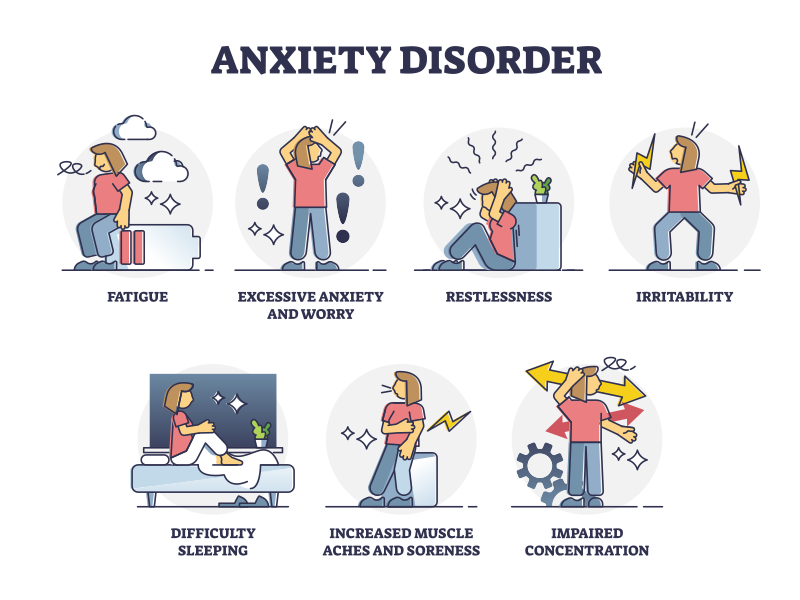
Anxiety looks different for everyone, but it often includes:
- Racing thoughts or constant “what ifs”
- Difficulty sleeping or relaxing
- Feeling tense, restless, or irritable
- Struggling to focus or make decisions
- Worrying about how others see you
- Avoiding situations that feel too overwhelming
Some people experience panic attacks — sudden, intense waves of fear with physical symptoms like a pounding heart, sweating, or shortness of breath. Others live with a steady undercurrent of dread or worry that never seems to let up.
Why anxiety feels so heavy today
Life today can feel like a perfect storm for anxiety. Many women I work with feel pulled in every direction — juggling demanding jobs, family responsibilities, and social pressures while trying to meet impossibly high standards. Add in constant news cycles, social media, and a lack of real downtime, and it’s no wonder anxiety is on the rise.
When worry becomes more than “just stress”
Anxiety is a natural human response — it’s what makes us slam the brakes when a car swerves in front of us, or hustle to meet a deadline. But when anxiety lingers long after the stressor is gone, or when it shows up even without a clear reason, it can start to run your life. You may feel like your brain is stuck in overdrive, always preparing for the worst.
The good news: anxiety is treatable
Anxiety responds very well to treatment. With the right support, you can quiet the constant worry, feel calmer in your body, and begin to enjoy life more fully. Therapy can give you tools to:
- Challenge unhelpful thought patterns
- Calm your nervous system and reduce overwhelm
- Build confidence in social and professional situations
- Develop healthier coping strategies
- Create more balance and peace in your daily life
Finding the right approach for you
There are many effective therapies for anxiety, and what works best depends on your unique needs. Some options include:
- Cognitive Behavioral Therapy (CBT): Identifying and shifting unhelpful thoughts and behaviors.
- Somatic therapies: Calming the body’s stress response and releasing tension.
- Mindfulness-based approaches: Practicing presence and self-acceptance.
- Parts work (IFS): Healing inner conflicts and softening the inner critic.
- Trauma-informed therapies (like EMDR): Processing past experiences that fuel anxiety.
Sometimes, lifestyle changes or medication may also be part of the picture — but the most important thing is finding a personalized plan that helps you feel safe, supported, and hopeful.
Moving toward peace
Anxiety doesn’t have to keep running the show. With compassion and practical support, it is possible to shift from living in constant worry to feeling grounded, confident, and more present in your own life.
You don’t have to face this alone — start your healing journey today..
More information
Anxiety Disorder. National Institute of Mental Health. https://www.nimh.nih.gov/health/statistics/any-anxiety-disorder
Henning, M., Subic-Wrana, C., Wiltink, J., & Beutel, M. (2020). Anxiety Disorders in Patients With Somatic Diseases. Psychosomatic Medicine.
Nelson, H., Cantor, A., Pappas, M., & Weeks, C. (2020). Screening for Anxiety in Adolescent and Adult Women. Annals of Internal Medicine.
What’s the difference between stress and anxiety? American Psychological Association. https://www.apa.org/topics/stress/anxiety-difference
By Teresa Franz, LCSW.
Teresa is a licensed clinical social worker in Texas with a Master of Science in Social Work from the University of Texas at Austin. She has more than a decade of experience supporting women through trauma, anxiety, relational challenges, and major life transitions.
Her advanced training includes internal family systems, EMDR, cognitive processing therapy, prolonged exposure therapy, motivational interviewing, attachment work, and mindfulness-based cognitive therapy.
Read Teresa’s full bio here