Sharing the mental load with a partner can help
ease the burden
and promote more equality in the relationship.
By Teresa Franz, LCSW — licensed clinical social worker with over a decade of experience in trauma, anxiety, and women’s issues.
The mental load is the invisible mental work many women carry — the planning, tracking, and decision-making that keeps a household functioning. It’s the pressure of remembering everything, anticipating needs, and staying one step ahead, even when no one sees the effort behind it. At Hope Tribe Therapy, we help women recognize this hidden burden and learn healthier ways to share, communicate, and care for themselves.
Quick navigation
This invisible workload shows up in dozens of small, everyday ways — planning meals, coordinating schedules, remembering appointments, birthdays, school events, and choosing the right gifts. Each task may seem simple on its own, but together they create a constant mental strain that leaves many women feeling overwhelmed and emotionally stretched thin.
Research consistently highlights how widespread this imbalance is. Studies referenced by the Harvard Business Review show that women in heterosexual relationships tend to carry not only more household responsibilities, but also the ongoing mental tracking and planning that goes with them.
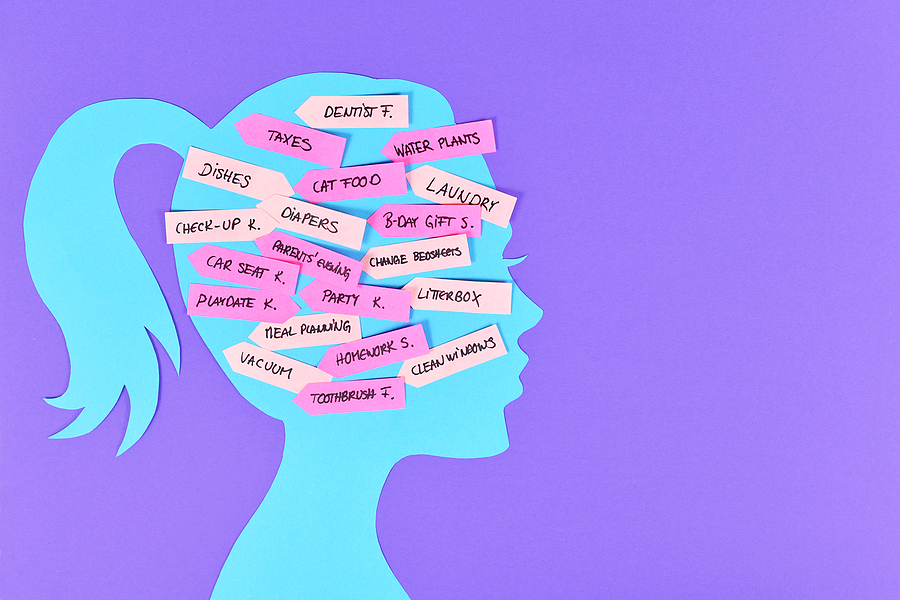
Additional findings from the Journal of Marriage and Family reveal that women in dual-earner households still spend more time on childcare and domestic tasks than their male partners, even when both partners work similar hours. At Hope Tribe Therapy, we see how this imbalance affects emotional well-being and relationships, and we support women in creating healthier boundaries, sharing responsibilities, and reducing the weight of the mental load.
When the mental load turns into cognitive overload
Cognitive overload happens when the demands on our minds exceed our mental capacity. Everyone has a limit to how much they can process at one time. When that limit is surpassed, it can lead to frustration, irritability, difficulty concentrating, reduced creativity, confusion, and fatigue.
The solution is more straightforward than it may seem, especially when you’re in the midst of cognitive overload. When you can identify what’s overwhelming your mind and find ways to manage, delegate, or simplify tasks, it becomes easier to regain focus, calm, and emotional balance. At Hope Tribe Therapy, we help clients recognize overload and develop practical strategies to lighten the mental burden and support overall well-being.
https://youtu.be/UpA6RdE0aYo?si=7BVW0B2UwyQTNCk_&t=40
Women can share the mental load with their partners
Open communication
Begin with an honest conversation with your partner about the mental load. Explain how it affects you and why sharing responsibilities is essential for both your well-being and the health of your relationship.
Make a to-do list
List all household and family tasks, then divide them between you and your partner. This could be a physical list or a shared digital calendar to keep everyone on the same page.
Prioritize tasks
Identify the most important responsibilities and ensure they are distributed fairly. Focus on what matters most rather than trying to do everything at once.
Delegate and teach
If your partner is unsure how to complete certain tasks, take the time to guide them. Teaching empowers them to take ownership and helps lighten your mental load.
Educate about preferences
Help your partner understand why specific tasks are meaningful to you. This allows them to handle responsibilities in ways that align with your household expectations without you having to manage everything alone.
Weekly check-ins
Set aside time each week to review tasks, track progress, and adjust responsibilities if needed. Regular check-ins promote fairness and prevent resentment.
Stay flexible
Sharing the mental load doesn’t always mean a perfect 50/50 split. Be willing to adjust when one partner needs to take on more due to work, life demands, or other circumstances.
Release perfectionism
Your partner may approach tasks differently than you do, and that’s okay. Letting go of perfection can reduce stress and foster appreciation for their efforts. Recognize and celebrate contributions, even if the approach differs from your own.
What women (and their partners) should know
Cognitive and emotional
The mental load is a combination of cognitive and emotional labor.
No boundaries!
Emotional labor is often invisible, boundaryless, and enduring, particularly in family, work, and social contexts.
Emotional labor can be measured in your body
Mental load can be assessed using physiological parameters such as heart rate, blood pressure, and respiratory changes. These measures help in understanding the biological costs of mental load.
Techniques like EEG and eye movement analysis are used to evaluate mental load. Specific brain regions like the occipital lobe, can show sensitivity to mental load.
Mental load matters for safety
Understanding mental load is crucial in high-risk activities such as aviation and medicine. Monitoring mental load can enhance performance and reduce errors.
Engineering your relationships can reduce mental load
Awareness of mental load in interpersonal interactions can affect communication dynamics. When you and your partner recognize each other’s mental load, you can collaborate to get the cognitive burden for each of you down to manageable levels.

Sharing the mental load goes beyond dividing tasks. It requires a shift in perspective and a mutual recognition of the effort involved in managing a household and family. At Hope Tribe Therapy, we help couples create more balanced, supportive partnerships by addressing mental load together and fostering healthier communication.
At Hope Tribe Therapy, we help women and couples reduce stress, improve communication, and create a more balanced, supportive home life. Schedule a session today and start lightening your mental load.
By Teresa Franz, LCSW.
Teresa is a licensed clinical social worker in Texas with a Master of Science in Social Work from the University of Texas at Austin. She has more than a decade of experience supporting women through trauma, anxiety, relational challenges, and major life transitions.
Her advanced training includes internal family systems, EMDR, cognitive processing therapy, prolonged exposure therapy, motivational interviewing, attachment work, and mindfulness-based cognitive therapy.
Read Teresa’s full bio here
Sources & suggested reading
Boyes, A. (2020, August 12). Sharing the mental load: How to create an equal relationship. Harvard Health Publishing.
Charles, R., & Nixon, J. (2019). Measuring mental workload using physiological measures: A systematic review. Applied ergonomics, 74, 221-232. https://doi.org/10.1016/j.apergo.2018.08.028.
“The Invisible Workload That Drags Women Down” by Brigid Schulte, The New York Times, April 2, 2019.
Dean, L., Churchill, B., & Ruppanner, L. (2021). The mental load: building a deeper theoretical understanding of how cognitive and emotional labor overload women and mothers. Community, Work & Family, 25, 13-29. https://doi.org/10.1080/13668803.2021.2002813.
Díaz-García, J., González-Ponce, I., Ponce-Bordón, J., López-Gajardo, M., Ramírez-Bravo, I., Rubio-Morales, A., & García-Calvo, T. (2021). Mental Load and Fatigue Assessment Instruments: A Systematic Review. International Journal of Environmental Research and Public Health, 19. https://doi.org/10.3390/ijerph19010419.
Kamp Dush, C. M., & Schoppe-Sullivan, S. J. (2018). Who does the housework? The division of labor within the home. Journal of Marriage and Family.
Schulte, B. (2019, April 2). The invisible workload that drags women down. The New York Times.
Segran, E. (2021, May 4). Women still do more household chores than men. Why? Fast Company.
Zheng, X., Wang, H., Hao, T., Chen, S., Xu, K., & Wang, Y. (2024). Evaluation of mental load using EEG and eye movement characteristics. Ergonomics, 1-22. https://doi.org/10.1080/00140139.2024.2342439.